11 Questions to Ask an AEO Agency Before You Hire
By Ashmeet Singh, Head of Branding & Marketing · Updated 14 October 2026 · 8 min read
ChatGPT drives the bulk of AI referral traffic, so getting cited matters. Use these 11 questions to tell a real Answer Engine Optimisation specialist from an SEO shop in a new coat.
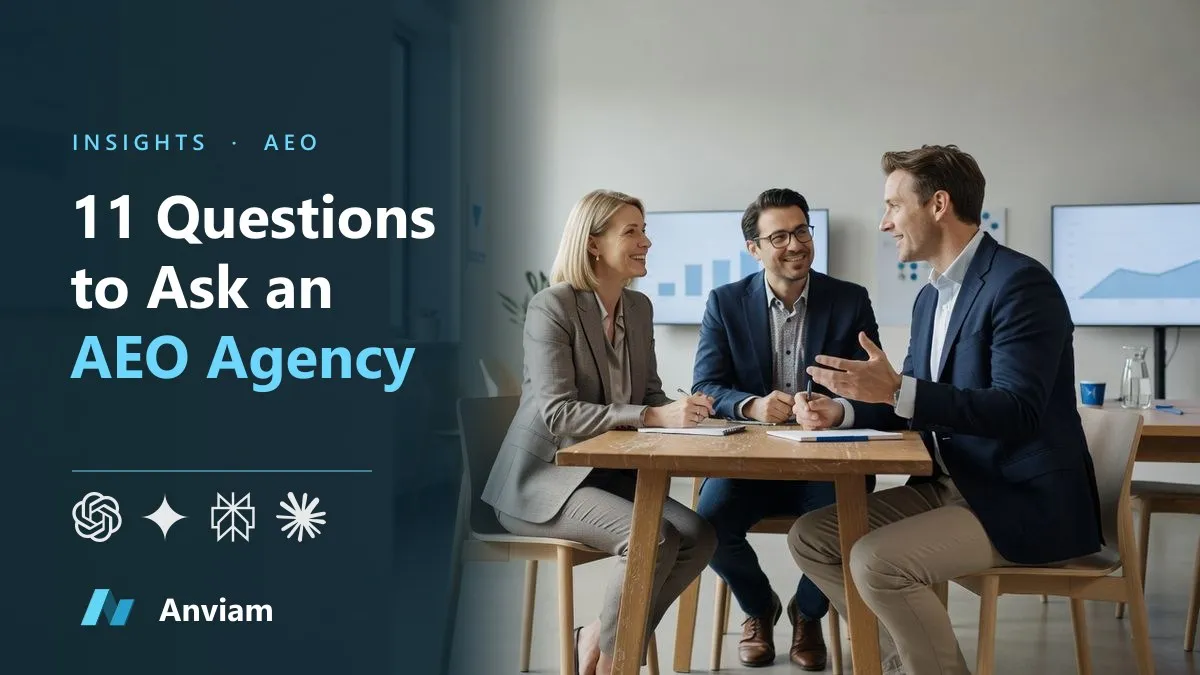
ChatGPT now sends roughly 87% of all AI referral traffic (Conductor, 2026), which means the answer engines have become a sales channel, not a science project. So the questions you ask an AEO agency before you hire decide whether your brand gets quoted inside those answers or quietly left out.
The catch is that Answer Engine Optimisation is new, and a lot of SEO shops have simply relabelled their old service as "AEO". This post gives you the 11 questions to ask an AEO agency on the sales call, with why each one matters, what a strong answer sounds like, and the red flag that tells you they're bluffing. For the wider picture, see our AEO service and the difference between GEO and AEO.
Quick answer
Ask an AEO agency how they measure success (share of voice in AI answers and citations, not just rankings), how they earn citations in ChatGPT, Perplexity and Google AI Overviews separately, how they handle schema and entity work, how they track AI referral traffic, how they prove ROI when answers are zero-click, who does the work, and what the exit terms are. A real specialist answers with method and numbers. A reskinned SEO agency changes the subject back to keyword rankings.
Real AEO specialist vs reskinned SEO agency
| Dimension | Real AEO specialist | Reskinned SEO agency |
|---|---|---|
| Primary KPI | Share of voice in AI answers, citations earned, assisted conversions | Keyword rankings and organic sessions |
| Engine targeting | Separate plays for ChatGPT, Perplexity and AI Overviews | One "do SEO and hope" approach for all of them |
| Content method | Answer-first copy, FAQ and comparison tables built to be quoted | Long intros, keyword density, thin FAQs bolted on late |
| Measurement | Tracks AI referral traffic and citation presence directly | Reports only Google Search Console and rankings |
| Attribution | Models zero-click and assisted value honestly | Claims every AI mention as a direct sale |
How we'd answer these ourselves
When a buyer asks us these questions, we lead with the KPI, not the tactic. We report citation presence per engine, AI referral sessions as a tracked source, and assisted conversions, then we show the schema and content changes that moved them. We also say plainly when a result is zero-click and still valuable. If an agency can't separate what it did from what the engine did, it can't be held to a number, and neither can you.
1. How do you measure AEO success, and what's the KPI?
A good AEO agency names its KPIs before you ask twice: share of voice inside AI answers, the number of prompts where your brand is cited, AI referral sessions, and assisted conversions. Rankings are a supporting metric, not the headline.
- Strong answer: "We track how often you're cited across a set of buying-intent prompts, then tie that to referral traffic and assisted revenue."
- Red flag: the KPI is still "first-page rankings" with AI treated as a free bonus.
2. How do you earn citations in ChatGPT, Perplexity and Google AI Overviews?
These engines don't work the same way, so one tactic won't win all three. ChatGPT and Perplexity lean on retrieval and fresh, well-structured sources, while AI Overviews pull from what already ranks in Google. With ChatGPT and Perplexity together taking about 78% and 15% of AI referral traffic (SE Ranking, 2025), a specialist can tell you where your audience actually asks.
A strong answer separates the three with concrete plays: structured, quotable sources for the chat engines, strong entity signals for Perplexity, and classic topical authority feeding AI Overviews. The red flag is treating all AI as one box labelled "ChatGPT".
See where AI search is hiding your brand
Get a free AI-visibility audit. We'll show where you're missed in Google and AI answers, and the fastest way to get cited.
3. What's your approach to schema, structured data and entity work?
Schema and entity work are how you make a brand legible to a machine. A capable agency talks about marking up FAQs, products, articles and organisation details, plus building a consistent entity across your site, Wikipedia, Wikidata and trusted third-party sources so the engines know who you are and trust the match.
- Strong answer: they connect schema to a knowledge-graph goal, not just "we add JSON-LD".
- Red flag: schema is described as a one-off technical task that's "already done".
- Follow-up: ask how they keep entity data consistent as your products change.
4. How do you write content that answers the question directly?
Answer engines quote the source that answers fastest and cleanest. So the content method should be answer-first: the direct answer in the opening lines, clear FAQ blocks, comparison tables, and headings written as the real questions buyers type. That is how a passage becomes quotable.
You can see the pattern in this very post and in our GEO agency question list. The red flag is a writer who still opens with three throat-clearing paragraphs before the point.
5. Do you track AI referral traffic, and how?
If an agency can't show you traffic arriving from AI sources, it can't prove the work. A real specialist sets up referral tracking for chatgpt.com, perplexity.ai, gemini and the rest, tags those sessions in analytics, and watches which pages get pulled into answers.
A strong answer describes the exact tracking setup and admits the gaps, because some AI citations send no referrer at all. The red flag is a vague "we'll see it in Google Analytics" with no plan for the traffic that AI hides.
6. How do you prove ROI when AI answers are often zero-click?
This is the hardest question, and the most revealing. When an AI summary appears, users click a link inside it only about 1% of the time (Pew Research, 2025), so a lot of value is a citation that never becomes a click.
A strong answer models the mix: tracked referral conversions where clicks happen, plus assisted and brand-search lift where they don't, reported honestly. The red flag is an agency that claims every AI mention as a direct, attributable sale. That's not confidence, it's invention.
If an agency promises you clean, click-based attribution from AI answers, walk away. The honest ones tell you where the data goes dark and show you how they measure around it.
— Ashmeet Singh, Head of Branding & Marketing, Anviam
7. What's your reporting cadence, and what's actually in the report?
You want a monthly report at minimum, and it should open with the KPIs, not a wall of activity logs. A good report shows citation presence by engine, AI referral sessions, the prompts you're winning and losing, and the next month's plan tied to a target.
- Strong answer: "Monthly, with a live dashboard you can open any day."
- Red flag: quarterly PDFs full of tasks completed and no outcome in sight.
8. Can you show AEO results or a clear methodology?
AEO is young, so very few agencies have years of case studies, and that's fine. What matters is whether they can walk you through a repeatable method and at least one worked example of a brand they moved into AI answers. Our roundup of the best AEO agencies is a useful shortlist to compare against.
A strong answer is a clear, step-by-step method even where the case studies are thin. The red flag is a decade of generic SEO wins presented as AEO proof, which tells you the label changed and the work didn't.
9. Who actually does the work, in-house or outsourced?
Ask who will touch your account day to day, and whether writing, technical schema work and analytics sit under one roof. AEO needs those skills to talk to each other, and a chain of subcontractors tends to drop the handovers.
- Strong answer: named roles, a clear point of contact, and the work kept in-house or with vetted long-term partners.
- Red flag: they can't tell you who writes your content or who runs the technical side.
- Follow-up: ask who owns the accounts and logins when the contract ends.
10. What are your contract length and exit terms?
AEO is a build, not a quick switch, so expect a realistic runway rather than overnight promises. That said, a fair agency doesn't trap you. Look for a sensible minimum term, a clear notice period, and the right to keep everything produced for you.
A strong answer is plain about timelines and hands you full ownership of content, schema and data on exit. The red flag is a long lock-in with early-termination penalties and content you can't take with you.
11. How do you keep up as the engines change?
The answer engines rewrite their own rules often, so an AEO agency has to test constantly. A strong answer describes how they run experiments, watch citation shifts, and adjust, the same discipline behind proper generative engine optimisation. The red flag is a fixed playbook from 2024 that hasn't changed since.
Where AEO is heading, and what to do next
AI referrals are still around 1% of web visits, but that share is growing roughly a percentage point a month (Conductor, 2026). The brands that get cited now will own those answers as the volume climbs, so picking the right partner is a timing decision as much as a budget one.
Take these 11 questions into every sales call, and hire the agency that answers with method and numbers rather than buzzwords. When you're ready, explore our AEO service or request a free quote and we'll walk you through exactly how we'd answer each one for your brand.
What is an AEO agency?
An Answer Engine Optimisation agency works to get your brand cited inside AI answers from ChatGPT, Perplexity, Google AI Overviews, Claude and Gemini, rather than only ranking blue links. A real specialist measures citations and AI referral traffic, not just keyword positions. See our AEO service for how this works.
What's the difference between an AEO agency and an SEO agency?
SEO optimises for ranking in search results; AEO optimises to be the quoted source inside AI-generated answers. Many SEO shops now relabel as AEO, so ask how they measure success. If the answer is still rankings alone, it's SEO with a new badge.
What KPIs should an AEO agency report?
Share of voice inside AI answers, the number of prompts where you're cited, AI referral sessions by source, and assisted conversions. Rankings and organic sessions are supporting metrics, not the headline.
How do I know if an AEO agency is legitimate?
Ask for a repeatable method, proof they track AI referral traffic, and honesty about zero-click measurement. A legitimate agency separates what it did from what the engine did and won't claim every AI mention as a direct sale.
Do I need an AEO agency or a GEO agency?
The two overlap heavily and many teams do both. AEO focuses on being cited in direct answers, GEO on visibility across generative results broadly. Our guide on GEO vs AEO explains which fits your goals.
How long before an AEO agency shows results?
Expect a build measured in months, not days. Schema, entity signals and answer-first content take time to be picked up, and citations grow as trust builds. Be cautious of any agency promising overnight AI visibility.
Was this article helpful?
Rate it and, if you like, drop a question for Ashmeet. We read every one.

Written by
Ashmeet Singh
Head of Branding & Marketing, Anviam
Ashmeet leads branding and marketing at Anviam, where he builds search and AI-visibility programmes for B2B and consumer brands across the UK and Europe. He works day-to-day on SEO, GEO and AEO strategy, helping brands get found in both classic search and AI answer engines like ChatGPT, Perplexity and Google AI Overviews.
Want results like these for your brand?
Book a free consultation and we'll return a prioritised growth plan within five working days.
Get a free consultation →