The Role of Predictive Analytics in Digital Marketing
By Ashmeet Singh, Head of Branding & Marketing · Updated 10 October 2026 · 7 min read
Predictive analytics in digital marketing uses your own data to forecast who will buy, who will leave and where your next pound is best spent. Here are the real use cases, the honest limits, and how to start.
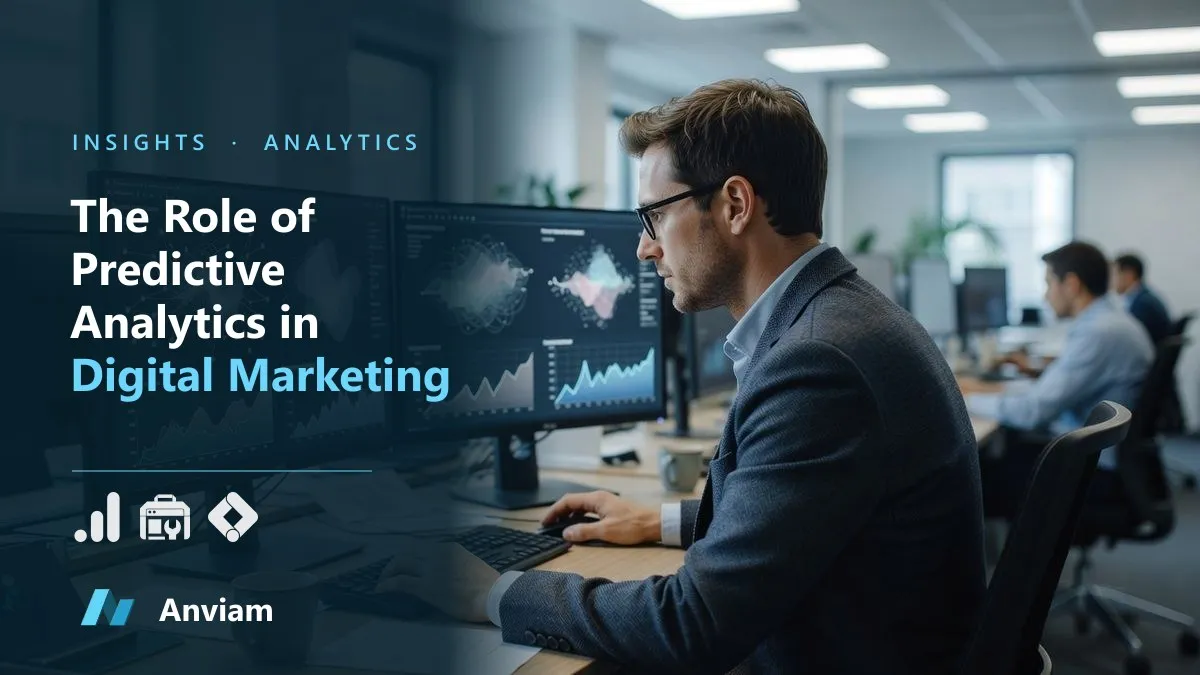
Most marketing teams are sitting on years of data they only ever use to explain the past. Predictive analytics in digital marketing flips that round: it reads the same customer data to make an informed bet on what happens next, so you can act before a sale is lost rather than report on it afterwards. That shift from looking back to looking forward is where the value sits.
This guide is for marketers who keep hearing that predictive analytics will transform their results and want a straight answer on what it actually does. We cover what it is in plain terms, the use cases that pay off, a comparison of where to start, the limits nobody mentions in the sales deck, and the steps to get going without a data science team on day one.
Quick answer
Predictive analytics uses your historical and live data, plus statistical models, to forecast future customer behaviour: who is likely to buy, churn, click or convert. In marketing it powers lead scoring, churn prevention, smarter segmentation, customer lifetime value and campaign timing. It works best with clean data and a clear question, and it struggles when data is thin or the market shifts suddenly. Start small, prove one use case, then expand. If you want a partner to set it up, see our digital marketing services.
What predictive analytics actually means
Strip away the jargon and predictive analytics is pattern-matching at scale. It looks at what customers did before a known outcome, then watches your current customers for the same early signs. If people who cancelled tended to stop opening emails three weeks earlier, the model learns to flag quiet subscribers as a churn risk now.
It is different from standard reporting, which tells you what happened, and from descriptive analysis, which explains why. Prediction assigns a probability to something that has not happened yet. That probability is the thing you can act on: a score, a ranked list, a forecast number.
How a prediction gets made
You don't need the maths to use the output, but it helps to know the shape of the process, because every weak prediction traces back to one of these stages.
- Collect and clean data: purchase history, site behaviour, email engagement, support tickets and ad response, pulled into one place and de-duplicated.
- Pick a clear question: who will cancel in the next 30 days, which lead will close, which product someone buys next.
- Train a model: the model studies past examples where you already know the answer and learns the signals that preceded each outcome.
- Score and act: the model rates your live audience, and marketing acts on the scores with offers, reminders or budget shifts.
- Measure and retrain: you check whether the predictions came true and feed the results back so the model stays current.
See where AI search is hiding your brand
Get a free AI-visibility audit. We'll show where you're missed in Google and AI answers, and the fastest way to get cited.
The marketing use cases that pay off
Predictive analytics is only worth the effort where it changes a decision. These are the applications that consistently earn their keep.
Lead scoring
Instead of sales chasing leads in the order they arrived, a model ranks them by likelihood to convert. The team spends its time on the few that matter, and genuinely cold leads stop eating hours they never deserved.
Churn prediction
The model spots the quiet signs that a customer is drifting away, usually weeks before they cancel. That window is everything: a well-timed offer or a check-in call can save a relationship that a cancellation email could not.
Smarter segmentation
Age and location tell you who someone is, not what they will do. Predictive segments group people by behaviour and intent, so your message lands on people ready to act rather than a broad demographic that mostly isn't.
Customer lifetime value
Forecasting what a new customer is likely to be worth over time changes how much you'll sensibly spend to win them. It stops you overpaying for low-value sign-ups and underspending on the accounts that quietly fund the business.
Campaign and budget timing
Models can estimate when a customer is most likely to buy again and which channel tends to work for them, so spend and send times line up with real behaviour instead of a calendar someone set last year.
Where to start with predictive analytics
| Use case | Best for | Data you need |
|---|---|---|
| Lead scoring | B2B and high-consideration sales | Past leads with known won/lost outcomes |
| Churn prediction | Subscriptions and retainers | Account activity and cancellation history |
| Customer lifetime value | Ecommerce and repeat-purchase brands | Order history over a reasonable time span |
| Behavioural segmentation | Email and campaign teams | On-site and engagement behaviour |
How we pick the first use case
At Anviam we don't start with the model, we start with the decision. We ask which repeated marketing decision is currently made on gut feel and costs real money when it's wrong. Then we check whether you hold enough clean history to predict it. The first project is almost always the one with the clearest question and the tidiest data, not the most exciting idea, because an early win buys the trust to do the harder ones. We wire the output into a tool the team already uses so nobody has to learn a new dashboard to benefit.
The limits nobody puts in the pitch
Predictive analytics is useful, not magic, and pretending otherwise is how projects lose credibility. Go in with clear eyes.
- It needs decent data. Thin, messy or short history gives shaky predictions, and no clever model rescues bad inputs.
- It assumes tomorrow resembles yesterday. A sudden market shift, a viral moment or a new competitor can break a model that was accurate a month ago.
- A score is a probability, not a promise. Some flagged customers won't churn and some unflagged ones will, so you manage odds, not certainties.
- It can bake in old bias. If past data under-served a group, the model can quietly keep doing it unless you check for that.
None of this is a reason to avoid it. It is a reason to treat predictions as strong input to human judgement, not a replacement for it.
How to get started without a data team
You can begin smaller than you think. Many marketing and CRM platforms now ship predictive scoring you can switch on with the data you already hold. Pick one decision, run the prediction alongside your current approach for a few cycles, and compare results before you trust it with budget. If you want it built into a proper always-on system, that is where our marketing automation team can help connect the data, the model and the campaigns.
The teams that get real value from predictive analytics are the ones that pick a single boring decision and get it right, like which leads to call first. The ones that fail are chasing a grand AI dashboard before they've cleaned their data. Start with one question you'd bet money on, prove it, then earn the right to the ambitious stuff.
— Ashmeet Singh, Head of Branding & Marketing, Anviam
Where this is heading
Prediction is moving from a specialist tool into the everyday settings of the platforms marketers already run, and it increasingly sits next to automation so the forecast and the action happen together. The winners won't be the brands with the fanciest models; they'll be the ones asking sharper questions of cleaner data and acting on the answers quickly. If you want help turning your data into decisions that move revenue, explore our digital marketing services or request a free quote. For the wider picture, see how this fits with AI in digital marketing and the shift toward AI and automation in programmatic advertising.
What is predictive analytics in digital marketing?
It is the use of your historical and live customer data, combined with statistical models, to forecast future behaviour such as who will buy, click, convert or cancel. Marketing teams act on those forecasts to make better decisions before the outcome happens.
How is it different from normal marketing reporting?
Reporting tells you what already happened and why. Predictive analytics assigns a probability to something that has not happened yet, which is the part you can act on with offers, timing or budget changes.
Do I need a data scientist to use it?
Not to start. Many CRM and marketing platforms include predictive scoring you can switch on with your existing data. A specialist helps most when you want custom models or a system that feeds predictions straight into campaigns.
How much data do I need before predictions are reliable?
Enough clean history that covers the outcome you want to predict, with real examples of it happening. Thin or messy data produces shaky forecasts, so getting your records in order usually comes before any modelling.
What are the best first use cases?
Lead scoring, churn prediction, customer lifetime value and behavioural segmentation tend to pay off quickest because the decision is clear and the data usually exists. Pick the one tied to a decision that costs you money when it is wrong.
Can predictive models be wrong?
Yes. A score is a probability, not a guarantee, and a sudden market change can throw off a model that was accurate last month. Treat predictions as strong input to human judgement and keep checking them against real results.
Was this article helpful?
Rate it and, if you like, drop a question for Ashmeet. We read every one.

Written by
Ashmeet Singh
Head of Branding & Marketing, Anviam
Ashmeet leads branding and marketing at Anviam, where he builds search and AI-visibility programmes for B2B and consumer brands across the UK and Europe. He works day-to-day on SEO, GEO and AEO strategy, helping brands get found in both classic search and AI answer engines like ChatGPT, Perplexity and Google AI Overviews.
Want results like these for your brand?
Book a free consultation and we'll return a prioritised growth plan within five working days.
Get a free consultation →