AI Search Is Driving 11% to 31% More Enquiries: Anviam's Data Across 6 Industries
By Ashmeet Singh, Head of Branding & Marketing · Updated 22 October 2026 · 5 min read
AI search isn't only changing rankings, it's sending businesses more qualified enquiries. Anviam's data shows 11% to 31% growth across six industries. Here's why, and how to capture it.
Quick answer
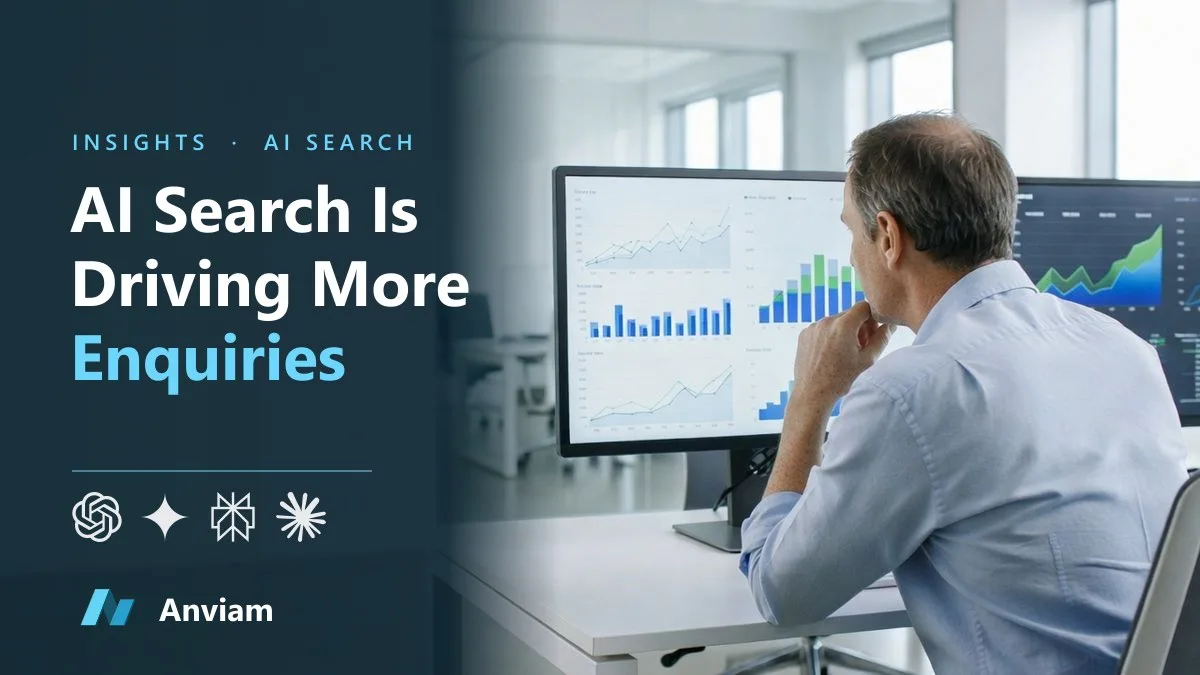
Across Anviam's client base, enquiries have risen between 11% and 31%, depending on the industry, since AI answers (Google AI Overviews, ChatGPT and the rest) became how buyers research. It isn't a ranking trick. AI now educates the buyer before they ever contact you, and ethically nudges them to act. The businesses that win are the ones AI can find, trust and recommend at the moment of that decision.
The data: enquiry growth by industry
Here's what we've measured across our clients since AI-assisted search became mainstream. These are representative figures from our own client base.
Enquiry growth by industry (Anviam client data, 2026)
| Industry | Increase in enquiries |
|---|---|
| Legal practitioners | +31% |
| Automotive repairs | +23.3% |
| Doctors & healthcare | +20% |
| Home services & repairs | +18% |
| Fintech | +12% |
| Fitness & wellness | +11% |
Two things stand out. First, every industry is up, not down, even as people click fewer blue links. Second, the biggest gains are in high-consideration, "I need the right expert" categories like legal and automotive. That isn't a coincidence, and it's the whole point. For most of these clients, Google AI Overviews is now the single biggest source of this new traffic, with the ChatGPT app close behind, 10% or more of the new enquiries on its own.
Why enquiries are rising, not falling
The headline fear about AI search is that it steals the click. Sometimes it does. But that misses what's happening underneath: AI has turned casual searchers into educated, high-intent buyers.
Here's a real example. A driver sees an unfamiliar yellow warning light on the dashboard. A few years ago they'd have ignored it, or typed a vague query and bounced around forum threads. Now they photograph it, upload the picture to ChatGPT, Gemini, Claude, Grok or Copilot, and in one conversation they learn what the light means, how serious it is, roughly what the fix costs, who carries out that repair, and who the best option near them is. Then, and only then, they raise an enquiry.
That buyer arrives knowing more than most front-desk staff. They don't need convincing that they have a problem. They need the right business to solve it.
There's a quieter force at work too: AI is an ethical adviser. It won't tell someone to keep driving a car that's flagging a fault. It won't tell someone to ignore a health symptom. It won't tell someone they shouldn't try to get fitter. By guiding people toward the sensible, healthy, sorted outcome, AI gives them both permission and motivation to spend on the solution. The demand that reaches your inbox is bigger, and better qualified, than it was.
My honest view, after tracking this across six industries: AI search isn't shrinking the market. It's expanding and pre-qualifying it. The only losers are the businesses AI can't see.
See where AI search is hiding your brand
Get a free AI-visibility audit. We'll show where you're missed in Google and AI answers, and the fastest way to get cited.
How we track it: the Anviam AI-Visibility Method
You can't improve what you can't measure, and standard analytics bury AI-driven demand inside "direct" and "organic". Here's the process we run.
- Bot-infrastructure audit. We check server logs for GPTBot, PerplexityBot and ClaudeBot, make sure they aren't blocked, and isolate a clean "AI assistants" channel in analytics. If the bots crawl but you're not cited, the problem is trust, not access.
- Edge-level fixes. We patch crawlability and metadata at the server edge (Cloudflare Workers), so models parse the site cleanly without waiting on a dev backlog.
- AI-visibility index. We measure your share of voice across all six engines (ChatGPT, Perplexity, Gemini, Copilot, Google AI Overviews, Grok) to see which recommend you and which are blind to you.
- Intent-gap mining. We break down the real intent behind your key terms and trace the off-site sources AI leans on, the specific subreddits, YouTube transcripts and forums, then plan to show up there too.
- Content grading. We score each page against the top-ranked answers and close the coverage gaps, so an engine treats your page as a complete answer worth quoting.
- Competitor interception. We track the exact prompts buyers ask ("best alternative to X for small teams") and watch which brands and URLs the AI cites, so we can take that slot.
- Fragment loopback. We read the text fragments AI highlights when it sends a visitor, then write more pages in that direct, bottom-line-first style the engines prefer to quote.
- Live data in the workflow. We wire live visibility data straight into our AI tools, so decisions run on current data, not last month's export.
We run this with enterprise-grade AI-visibility tooling that tracks over 481 million real buyer prompts across the major engines, so the picture is market-level, not a handful of manual checks. It is the discipline behind our generative engine optimisation and answer engine optimisation work.
What this means for your business
- Invisible to AI is the new page two. If ChatGPT and AI Overviews don't mention you, you're not in the running for that pre-qualified enquiry, however well you rank on classic Google.
- Every engine counts. It's tempting to optimise for ChatGPT and stop. Gemini, Copilot, Perplexity and Grok each serve millions of people a day. Ignoring the "smaller" ones leaves real money on the table.
- AI rewards honest, useful content. Over the last year the pattern is clear: freshness, genuine authority, content that actually solves the problem, clear benefit statements, a question-and-answer structure, and plain honesty. There's no trick. Be the most useful, clearest, most trustworthy answer and the engines quote you.
How to capture this demand
- Make sure AI crawlers can reach you, and that you can measure them.
- Audit where you're cited, and missed, across all six engines.
- Rewrite your key pages answer-first, so the one-line answer an engine wants to quote sits right at the top.
- Build the third-party proof (reviews, mentions, community presence) AI leans on.
- Track your share of AI answers over time and keep closing the gaps.
If you'd rather have a partner run this, see our guide to the best GEO agencies in the UK and how it compares to classic search in GEO vs SEO. Want to see exactly where you stand? We run a free AI-visibility audit that shows where you're cited and missed across the major engines.
FAQ
Is AI search reducing website traffic?
Clicks on some informational queries are down. But for businesses that get cited, qualified enquiries are up, between 11% and 31% across the industries we track, because AI sends people who are ready to act.
Which AI engine should I optimise for first?
Start with Google AI Overviews and ChatGPT, since they drive the most referrals for most of our clients, but don't stop there. Gemini, Perplexity, Copilot and Grok each reach millions of users.
How is AI-driven traffic different from normal SEO traffic?
It's more qualified. The person has already used AI to understand their problem and their options, so they arrive closer to a decision. Your job is to be the business the AI named.
How do I know if AI is sending me customers?
Most of it hides in "direct" and "organic" in standard analytics. You need to isolate an AI-assistant channel and track citations across engines, which is what our AI-visibility method does.
What content does AI prefer to cite?
Fresh, authoritative, genuinely useful content with a clear answer up front, a question-and-answer structure, honest claims, and third-party proof. Clean writing for humans is the optimisation.
Celebrating 10+ years of digital marketing and web development excellence.
Was this article helpful?
Rate it and, if you like, drop a question for Ashmeet. We read every one.

Written by
Ashmeet Singh
Head of Branding & Marketing, Anviam
Ashmeet leads branding and marketing at Anviam, where he builds search and AI-visibility programmes for B2B and consumer brands across the UK and Europe. He works day-to-day on SEO, GEO and AEO strategy, helping brands get found in both classic search and AI answer engines like ChatGPT, Perplexity and Google AI Overviews.
Want results like these for your brand?
Book a free consultation and we'll return a prioritised growth plan within five working days.
Get a free consultation →