How to Rank in 'Near Me' Searches with Google Business Profile
By Ashmeet Singh, Head of Branding & Marketing · Updated 10 October 2026 · 8 min read
A practical 2026 playbook for ranking in the Google local pack and 'near me' searches: optimise your Google Business Profile, build location pages, earn reviews, and prove you're genuinely local.
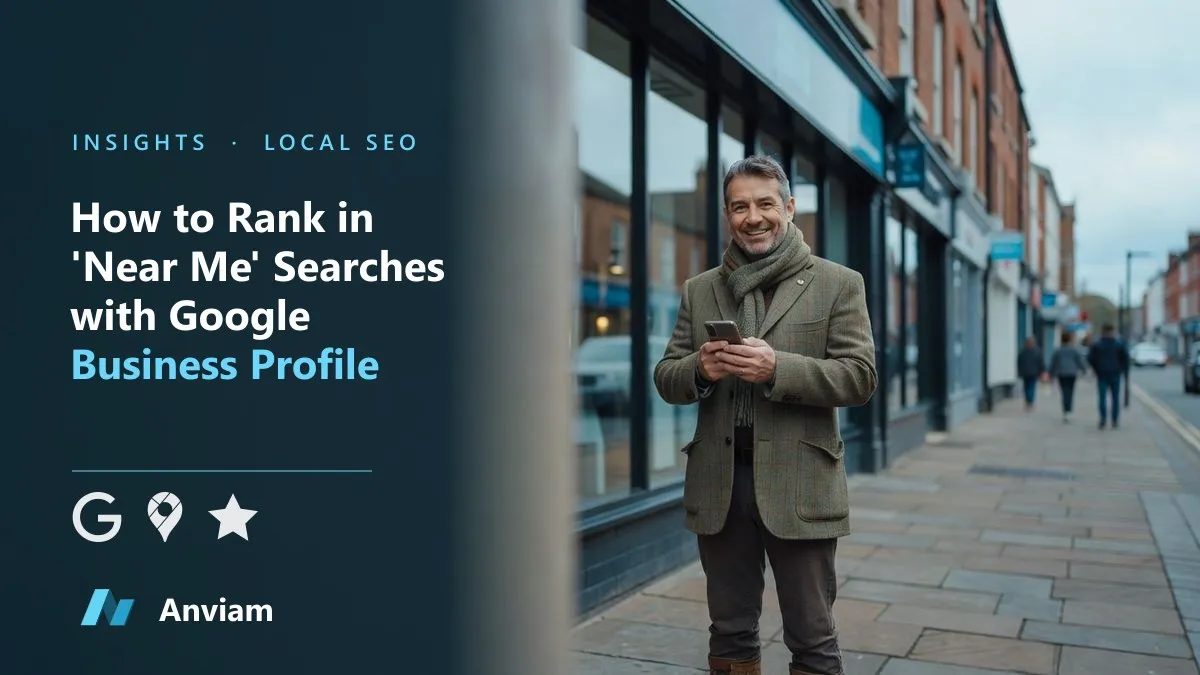
Most local buyers never scroll past the three businesses Google shows in the map pack, and nearly half of local searches now carry a 'near me' intent (BrightLocal, 2025). A well-optimised Google Business Profile is what gets you into that pack, but on its own it rarely keeps you in the top three for competitive 'near me' searches.
This guide shows you how ranking in local search actually works in 2026: how Google picks the local three, exactly what to put on your profile, and the signals on your own website that decide the order. Every step here is something you can action this week, not a vague theory.
Quick answer
To rank in 'near me' and the Google local pack, treat your Google Business Profile as step one, not the whole plan. Pick the right primary category, keep your name, address and phone identical everywhere, earn a steady flow of recent reviews with replies, and back it all up with a dedicated page on your own site for each location and service. Google ranks the pack on relevance, distance and prominence, so the winner is usually the business with the clearest match and the strongest proof it's a real, active local option.
How we built this
This playbook comes from the local SEO work our team runs for UK service businesses: multi-location clinics, trades, and retail with physical shops. We've grouped the tactics by the three factors Google itself names for local ranking (relevance, distance, prominence) and kept only the steps that moved map pack positions for real clients.
Why a Google Business Profile alone no longer ranks you
Almost every established business has now claimed its profile. When everyone has done the same thing, having one stops being an advantage and becomes the entry ticket. It gets you onto the board; it doesn't win you the game.
Google's local results lean heavily on proof. The engine wants evidence that you trade from where you say you do, that customers choose you, and that your details are consistent across the web. If your entire plan rests on one map listing, you'll slowly slip behind competitors who also show that proof on their own website and on other local platforms.
So the goal is simple: be the obvious best answer for a specific place and a specific service, and make that answer easy for Google to verify. That's a job for your profile and your website working together, which is why our organic SEO services treat the two as one system rather than separate tasks.
How Google actually ranks the local pack
Google orders local results on three things: relevance, distance and prominence. Relevance is how well your profile and site match what the searcher typed. Distance is how close you are to the searcher or the place they named. Prominence is how well known and trusted your business is, online and off.
You can't move your premises closer to every customer, so distance is mostly fixed. The two factors you can genuinely improve are relevance and prominence, and almost everything below is about making both stronger.
The three local ranking factors and where you influence them
| Factor | What it means | Where you act on it |
|---|---|---|
| Relevance | How closely your profile and pages match the search | Primary category, services, and location or service pages on your site |
| Distance | Proximity to the searcher or named area | Mostly fixed, but service-area settings and local pages help for nearby towns |
| Prominence | How known and trusted you are | Reviews, citations, local links, and brand mentions across the web |
See where AI search is hiding your brand
Get a free AI-visibility audit. We'll show where you're missed in Google and AI answers, and the fastest way to get cited.
Optimise your Google Business Profile the right way
Get the primary category right
Your primary category is one of the single biggest relevance signals in the whole system. Pick the most specific category that describes what you do, not a broad one. A 'dental clinic' ranks for different searches than a 'cosmetic dentist', so choose the term your best customers actually search for, then add secondary categories for your other services.
Keep your details identical everywhere
Your business name, address and phone number must match exactly on your profile, your website and every directory you appear on. Even small differences, like 'Street' on one and 'St' on another, weaken the trust signal. Audit them once, fix the mismatches, and keep a single source of truth so staff never re-enter them differently.
Fill every field and keep it fresh
- List all your services and products with short, keyword-aware descriptions.
- Add real photos of your premises, team and work, and refresh them regularly.
- Set accurate opening hours, including holidays, so you don't lose trust with a wasted journey.
- Post updates, offers and events so the profile looks active rather than abandoned.
- Answer the Q&A section yourself before customers post misleading answers for you.
Win 'near me' with location pages on your own site
One of the most common mistakes is a single page that lists every town you serve. That confuses Google and reads as thin to customers. In 2026 the businesses that win 'near me' searches build a dedicated, genuinely useful page for each location and each core service.
A strong local page names the area in the heading and copy, answers the questions local buyers ask, shows reviews and photos from that area, and links to the relevant service. Done well, this is the backbone of a hyperlocal marketing approach that compounds over time rather than one thin landing page.
- Create one page per location you genuinely serve, with the area in the title and URL.
- Write original copy for each: directions, parking, local landmarks, and FAQs specific to that area.
- Embed a map, your profile reviews, and photos taken at or near that location.
- Link each location page to the matching service page and back to a clear contact or quote step.
- Add LocalBusiness structured data so Google can read your name, address and hours cleanly.
Reviews are the signal that moves the pack
Reviews feed prominence more directly than almost anything else. Google looks at how many you have, how recent they are, your average rating, and whether you reply. A business with a steady trickle of fresh, detailed reviews usually outranks one with a bigger but stale pile.
- Ask every happy customer, every time, with a short link or QR code that opens your review form.
- Reply to all reviews, good and bad, within a day or two, and name the service in your reply.
- Encourage reviewers to mention the service and the town, because that text becomes relevance.
- Never buy or incentivise reviews, which breaks Google's rules and risks your profile.
Reviews now travel beyond the map pack too: assistants and AI answers increasingly summarise what people say about you. We've written separately on how Google reviews feed AI recommendations and why your reply voice matters more than it used to.
The businesses that win 'near me' aren't the ones chasing every ranking trick. They're the ones who make it genuinely obvious, to Google and to a human, that they're the best local choice: a precise profile, a real page for each place they serve, and a steady habit of earning and answering reviews. Do those three consistently and the pack tends to sort itself out.
— Ashmeet Singh, Head of Branding & Marketing, Anviam
Local citations and links that prove you're real
Citations are mentions of your business details on other sites: directories, local press, trade bodies and community pages. Consistent citations back up your profile and tell Google your business is established and active in a place.
- Claim the core directories first, then relevant industry and local ones, with identical details.
- Earn mentions and links from local organisations, suppliers, sponsorships and news, not just directories.
- Fix or remove duplicate and outdated listings that split your signals across the web.
Track what's working, not just where you rank
Rankings in local search vary by the searcher's exact location, so a single 'position' tells you little. Track outcomes instead: calls, direction requests, form fills and bookings, and watch how they trend as you ship each change.
- Use your profile's own insights for calls, direction requests and search terms.
- Set up call tracking and form tracking so you can tie leads back to local pages.
- Review a map-based rank tracker monthly to see position by area, not one blended number.
Where this is heading and what to do next
Local search is moving toward answers, not just links. Assistants and AI summaries are starting to pick a local business and recommend it, and they pull from the same signals that win the map pack today: a precise profile, consistent details, strong reviews and a credible website. The groundwork you lay for 'near me' ranking is the same groundwork that gets you recommended when the answer is generated rather than listed.
Start with the three highest-impact moves: fix your primary category and details, build a real page for every location, and make review collection a weekly habit. If you'd rather have a team run the full programme, see our organic SEO services or request a free quote and we'll map out your local search plan.
How long does it take to rank in 'near me' searches?
Most businesses see movement in the local pack within two to three months of consistent work, though competitive cities take longer. Profile fixes and category changes can show quickly; reviews and location pages build their effect over time.
Do I need a website to rank in the local pack?
You can appear with just a profile, but the top positions in competitive searches almost always go to businesses with a strong, relevant website. Your site is where you prove relevance and depth that a profile alone can't carry.
Is my Google Business Profile category really that important?
Yes. The primary category is one of the strongest relevance signals Google uses for local results. Choosing the most specific, accurate category for your main service is one of the highest-impact changes you can make.
How many reviews do I need to rank well?
There's no fixed number, because Google weighs recency, rating and reply rate alongside volume. A steady flow of recent, detailed reviews with your replies usually beats a larger but older set.
Should I build a page for every town I serve?
Build a genuine page only for places you truly serve and can write unique, useful content for. Thin, near-duplicate pages for dozens of towns tend to hurt more than help, so quality beats quantity here.
Can an agency manage local SEO for multiple locations?
Yes, and multi-location businesses usually benefit most from a managed programme because the work scales fast. You can request a free quote from us and we'll scope the profiles, pages and reviews across every location.
Was this article helpful?
Rate it and, if you like, drop a question for Ashmeet. We read every one.

Written by
Ashmeet Singh
Head of Branding & Marketing, Anviam
Ashmeet leads branding and marketing at Anviam, where he builds search and AI-visibility programmes for B2B and consumer brands across the UK and Europe. He works day-to-day on SEO, GEO and AEO strategy, helping brands get found in both classic search and AI answer engines like ChatGPT, Perplexity and Google AI Overviews.
Want results like these for your brand?
Book a free consultation and we'll return a prioritised growth plan within five working days.
Get a free consultation →