What Is Hyperlocal Marketing? A 2027 Playbook
By Ashmeet Singh, Head of Branding & Marketing · Updated 23 October 2026 · 9 min read
Most local businesses draw customers from a few streets or a few miles, not a whole region. Here's how to win that catchment with local SEO, Google Business Profile and radius-targeted ads, for a fraction of a wide-net budget.
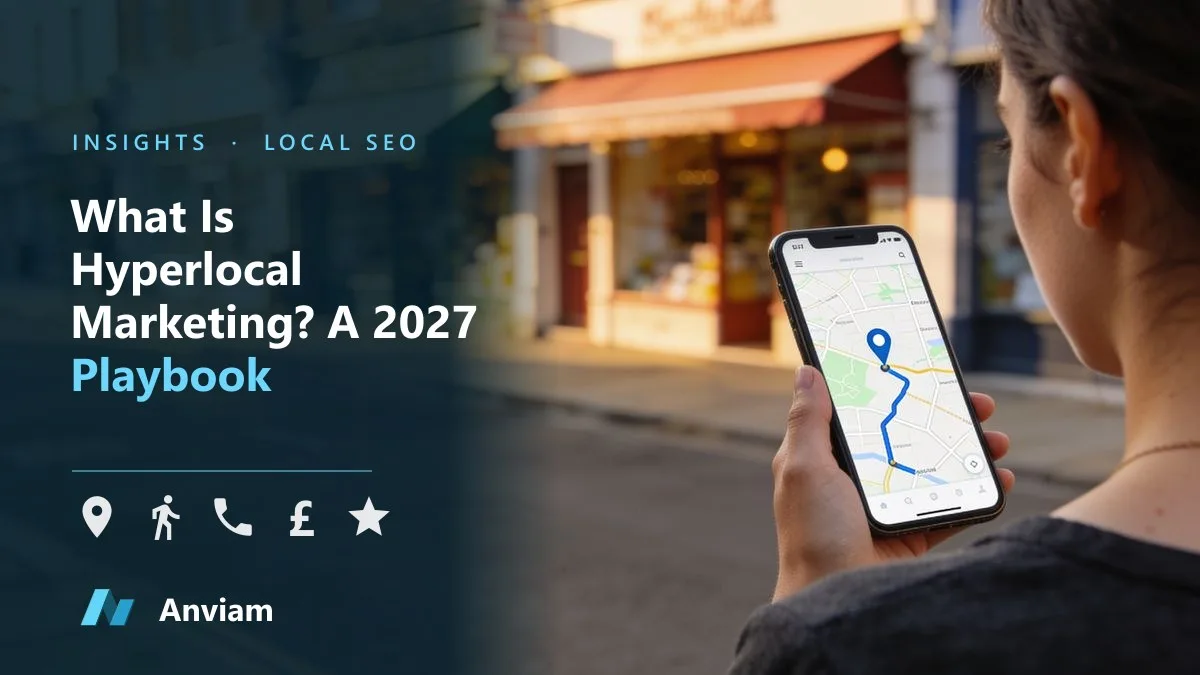
Most local businesses live or die on a surprisingly small patch of the map. A café depends on the next few streets. A dental practice pulls from a few miles. A specialist garage might draw from ten. Yet a lot of local marketing still sprays budget across a whole region, paying to reach people who were never going to walk in. Hyperlocal radius marketing fixes that by aiming everything at the catchment you actually serve.
The behaviour backs it up. Nearly half of consumers now say they always or often add "near me" to their searches (BrightLocal, 2025), and those searches carry high, immediate intent. Someone typing "dentist near me" or "MOT near me" is usually ready to book, not browsing. If your business is the one they find in that moment, you win the job. If it isn't, you never knew the job existed.
Quick answer
Hyperlocal radius marketing concentrates your local SEO, Google Business Profile and paid ads on the area your business actually serves. How wide that is depends on your trade: about a mile for a salon or shop, up to 15 miles for a dental or medical clinic, 15 to 20 miles for home services, and nationwide for anything delivered remotely. Nearby customers convert more easily, stay more loyal and cost far less to reach, so you win more for roughly a tenth of a nationwide budget.
What hyperlocal radius marketing actually means
Hyperlocal marketing is simply marketing aimed at a small, defined area rather than a broad region. The "radius" part is literal: you draw a ring around your location and point your visibility and ad spend at the people inside it. The right ring depends on how far people will realistically travel for what you do.
Typical radius by business type
| Business type | Typical radius |
|---|---|
| Retail, salons and cafés (walk-in) | Around 1 mile |
| Dental and medical clinics | Up to 15 miles |
| Home services (you travel to them) | 15 to 20 miles |
| Specialised services, e.g. care | Up to 30 miles, often with travel charges |
| Remote or online services | Nationwide |
Why nearby customers are the easiest to win and keep
Local customers are not just convenient. They are the most profitable kind of demand a small business can chase, for three reasons.
- They convert faster. Local intent is immediate. People are choosing, not researching, so the gap between finding you and booking you is short.
- They come back. Proximity plus a good first visit turns a one-off into a regular. Loyalty is far easier to earn when you are round the corner.
- They cost less to reach. You only pay to reach the few thousand people who could realistically become customers, and tightly targeted local terms are less contested than broad national ones.
Trust does a lot of the work at this range. Replying to reviews is one of the clearest signals: 88% of consumers say they would use a business that responds to all its reviews, against just 47% for one that never responds (BrightLocal, 2024). For a nearby buyer deciding between you and the place down the road, that can be the whole decision.
See where AI search is hiding your brand
Get a free AI-visibility audit. We'll show where you're missed in Google and AI answers, and the fastest way to get cited.
Which businesses it works best for
Hyperlocal works best when the customer and the business have to meet somewhere. If people come to you, or you go to them within a set area, your whole market is local by definition.
- Dental, medical, physiotherapy and aesthetics clinics
- Veterinary practices and opticians
- Care homes and home care
- Independent retail and boutiques
- Hair salons and barbers
- Gyms and fitness studios
- Cafés and restaurants
- Home services: cleaning, plumbing, electrical, heating
- Repair services: phone, computer, appliance
- Automotive: garages, MOT, car wash
Businesses that sell nationally online are a different game. For everyone on that list, though, a national campaign is mostly wasted reach.
How to run a radius campaign
A good radius campaign is not one tactic. It is three or four, aimed at the same small area and measured against real enquiries, not clicks.
- Set the radius from real data. Start with where your current customers actually come from, not a guess. How far people travel depends on your trade: about a mile for a salon or shop, up to 15 miles for a dental or medical clinic, 15 to 20 for home services, and nationwide for anything delivered remotely. Do not set it too tight.
- Own the map pack with local SEO and your Google Business Profile. A fully built Google Business Profile, local landing pages and consistent business details are what put you in the "near me" results. For most local businesses this is the highest-return work there is.
- Run radius-targeted ads. Google Ads and social ads let you geo-fence a tight ring around your door, so every click can plausibly become a booking rather than spend wasted on people too far away.
- Build reviews and local reputation. Ask every happy customer, reply to all of them, and keep your name, address and phone identical everywhere. For a nearby buyer, that is the tie-breaker.
Done together and kept up, these compound. The businesses that win treat it as a habit, not a one-off: a weekly profile post, a monthly review push, a fresh local page each quarter.
How small a budget can you really run on?
This is the part that surprises people. Because you are only paying to reach the people who could actually walk in, call or book, a focused single-city programme costs roughly a tenth of a nationwide one. As a rough guide it runs from a few hundred pounds a month (a medical clinic around £600 to £700, home services around £400 to £500), with about 30% more if you also want the outskirts and surrounding villages. Smaller audience, cheaper local terms, less competition. You are not buying reach you cannot use.
Our take
We would rather put a modest budget to work across the area a business genuinely serves and measure it against booked jobs than spread the same money thin across a region. The returns are easier to see, and far easier to defend to an owner watching every pound.
What we have learned doing this
In our experience the first thing to fix is the Google Business Profile, taken to 100%: every field, every service with keywords, real photos, correct hours and amenities, and working buttons to call, book and reach the site. Then the local directories that matter in your city, to the same standard, after proper competitor research. Then genuine, keyword-rich reviews from real customers, never fake ones. Most businesses that feel stuck have simply never done these properly.
Two myths hold local businesses back. The first is that you just need time, that clients will arrive if you wait. They will not, and sitting still while a competitor takes the work is lost revenue, not patience. The second is that word of mouth will grow you. Referrals are lovely but slow: check your own numbers and most months bring one or two, nowhere near enough. The businesses that win build a system that brings strangers to the door, and they do not set their radius too tight. The customers on the edge of town are often the most loyal, because almost no one bothers to reach them.
Getting started
- Map where your last 50 customers actually came from. That is your real radius.
- Claim and fully complete your Google Business Profile, then ask recent happy customers for a review.
- Make sure your name, address and phone match everywhere online.
- Launch one tight radius ad test and track calls and bookings, not clicks.
If you want a hand, our hyperlocal marketing service sets all of this up and runs it as one programme, and a free local visibility audit will show where nearby customers are searching and where you are being missed. For the day-to-day fundamentals, our guide to hyperlocal marketing goes deeper.
The local foundation a radius campaign sits on
A radius campaign only works if the basics underneath it are sound. Get these right before you spend anything on reach.
- Google Business Profile, completed properly. Correct categories, real opening hours, every service listed individually, photographs of the actual premises. For most local businesses this is the single highest-return hour of work available.
- Consistent name, address and phone number everywhere you appear: your site, Google, Bing, and the directories that matter in your trade. Mismatches quietly weaken local ranking.
- A real page per location if you have more than one, each with its own address, team and content. Not one page listing six branches, and not six near-identical pages with the town swapped.
- Genuinely local content. Catchment areas, parking, transport, nearby landmarks. Naming a town is not local content.
Why reviews do the heavy lifting
In a local decision, reviews often matter more than anything you write about yourself. They feed the map pack, they decide the click, and they increasingly shape what AI assistants say about you when someone asks for a recommendation nearby.
Ask at the moment the job is finished and the customer is pleased, not weeks later. Respond to every review, especially the critical ones, and respond like a professional rather than arguing. A calm, specific reply to a complaint reassures a future customer more than ten five-star ratings do.
How to tell whether a radius campaign is working
Ignore impressions and follower counts. In hyperlocal work the numbers that mean something are narrow and practical.
- Enquiries and calls by area, tracked properly, so you can see which parts of the radius actually convert.
- Local pack visibility for your main services across the towns you serve.
- Cost per enquiry by area, which usually reveals that one edge of your radius is far more expensive than the rest.
- Repeat and referral rates, because proximity businesses live on them.
The mistakes that cost the most
- Setting the radius by ambition rather than logistics. Covering an area you cannot service profitably just buys you enquiries you will turn down.
- Neglecting the Google Business Profile while spending on ads. The free asset usually outperforms the paid one locally.
- Treating every town the same. Duplicate pages with the place name swapped rarely rank and read badly.
- No review habit. Asking occasionally when you remember, rather than every time as part of the job.
What radius should my business target?
It depends on how far people travel for what you do. A café or barber lives on 500 metres to 1 mile of footfall, most clinics and retailers do well around 5 miles, and automotive or specialist services can pull from 10 miles. Set it from where your current customers actually come from, then refine it with the data.
Is hyperlocal marketing just local SEO?
Local SEO is the foundation, but it is not the whole thing. Hyperlocal combines local SEO and your Google Business Profile with radius-targeted Google and social ads and a steady flow of reviews, all aimed at the same small area. The tactics overlap with ordinary SEO and PPC; the difference is the tight geographic focus.
How quickly does it work?
Google Business Profile work and radius ads can bring enquiries within the first few weeks. The local SEO side, local pages, reviews and links, compounds over a few months. Most place-based businesses see a clear lift in calls and visits once the three run together consistently.
Does it work for service businesses that travel to the customer?
Yes. For a cleaner, plumber or mobile repair service, the radius is simply the area you are willing to travel to. You target the postcodes you serve and let the campaign bring you jobs inside that ring.
How much should I budget?
Less than most people expect, because the audience is small and local terms are cheaper and less contested than national ones. A hyperlocal campaign typically runs on a fraction of a region-wide budget. We scope a figure to your area and goals in a free consultation rather than quote a blanket number.
Was this article helpful?
Rate it and, if you like, drop a question for Ashmeet. We read every one.

Written by
Ashmeet Singh
Head of Branding & Marketing, Anviam
Ashmeet leads branding and marketing at Anviam, where he builds search and AI-visibility programmes for B2B and consumer brands across the UK and Europe. He works day-to-day on SEO, GEO and AEO strategy, helping brands get found in both classic search and AI answer engines like ChatGPT, Perplexity and Google AI Overviews.
Want results like these for your brand?
Book a free consultation and we'll return a prioritised growth plan within five working days.
Get a free consultation →