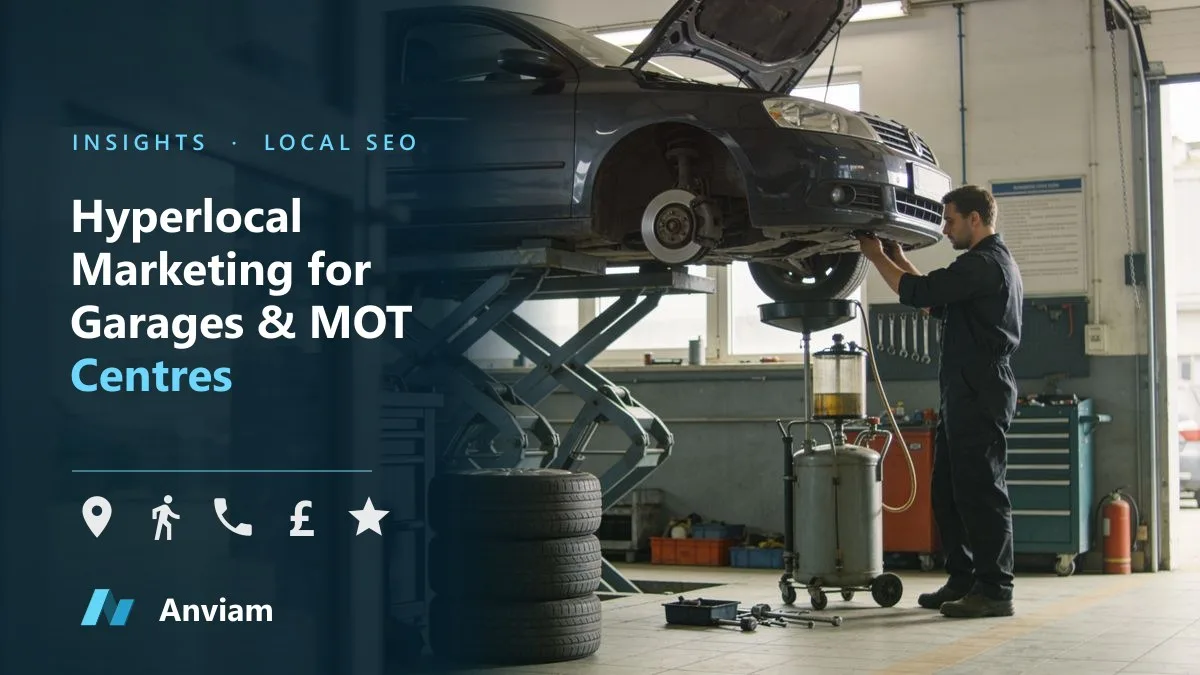
Hyperlocal Marketing for Garages & MOT Centres: More Local Bookings for Less (2027)
By Ashmeet Singh, Head of Branding & Marketing · Updated 23 October 2026 · 9 min read
Hyperlocal marketing fills a garage's diary with local drivers who book MOTs, servicing and repairs, for a few hundred pounds a month. Here is how we do it.
When a driver's MOT is due, a warning light comes on, or a tyre goes flat on the school run, they don't browse. They search, ring the first garage that looks trustworthy and close, and book. Radius marketing makes sure that garage is yours across the few miles where drivers actually choose. For most independent garages and MOT centres, it's a few hundred pounds a month and it fills the ramps with local work you'd otherwise lose to the big chains.
Quick answer
Radius marketing targets the drivers inside a set distance of your garage, usually up to 15 miles, and turns their "MOT near me" and "garage near me" searches into booked jobs. You fix your Google Business Profile first, get listed where it counts, build genuine reviews, then run tightly targeted ads. In our experience it roughly doubles daily enquiries for a few hundred pounds a month, a fraction of what a nationwide campaign costs.
What radius marketing means for garages and MOT centres
Radius marketing is simple: you decide how far a customer will realistically travel to you, then you concentrate every bit of your marketing inside that ring instead of spraying it across the whole country. For a garage that ring is tight. Nobody drives two counties over for an interim service when there's a decent garage down the road, but they'll happily travel 10 or 15 minutes for one they trust with the family car.
It works because car jobs are urgent and local by nature. An MOT is due on a fixed date, a knocking noise needs sorting this week, a failed brake test can't wait. That urgency is why the top result on a map pack wins the booking, and why hyperlocal marketing suits garages so well. Our guide on what radius marketing is breaks the approach down step by step.
Why nearby customers are the best
Nearby drivers convert faster, cost less to reach and come back year after year. A garage keeps a customer for every MOT, service and repair for as long as they own the car, and often for the next car too. Win a household once and you've won a decade of work, so the job is to be the obvious local choice at the moment they search.
And the search is where it starts. BrightLocal, 2025 found that 46% of consumers always or often add "near me" to their searches. Think "MOT near me", "garage near me", "tyres near me". Those aren't browsers. They're drivers with a problem and a card ready.
Here's the part most garages miss. Drivers on the edge of town and out in the surrounding villages are often the most loyal and the easiest to win, because fewer garages bother to reach them. They're used to driving into the city and settling for whoever they find. Stretch your radius to pull them in instead and they tend to stay for years. Under-set it and you'll quietly hand those households to a competitor nearer the ring road.
See where AI search is hiding your brand
Get a free AI-visibility audit. We'll show where you're missed in Google and AI answers, and the fastest way to get cited.
The right radius for a garage
No single number fits every garage, but the pattern's consistent. Routine, time-sensitive jobs pull from close by; trust and specialism pull from much further. We usually set the working ring at up to 15 miles, because that's how far most drivers will travel for a garage they rate, then push a little wider to reach the under-served villages.
How far drivers travel for different garage work
| Radius | What it covers |
|---|---|
| Up to 5 miles | Routine MOTs and quick jobs, town-centre sites and passing trade |
| Up to 15 miles | Most drivers travel this far for a garage they trust, servicing and repairs |
| 15 miles and beyond | Specialist, diagnostic or marque work drivers seek out by name |
A town-centre MOT station on quick turnaround might focus the first five miles hard, while a specialist diesel or marque garage can cast wider, because drivers will travel for the right expertise. Set the ring to match the work you actually want more of.
How we win it
The order matters. Do the free, high-impact groundwork before you spend a penny on ads, or you'll pay to send clicks to a profile that doesn't convert. Here's the method we run, in sequence.
- Get the Google Business Profile to 100% first. Every field completed, every service listed with the words drivers actually search (MOT, servicing, cambelt, clutch, diagnostics, tyres), real photos of the workshop and team, correct hours, and working call, book and website buttons that match the site. This single step moves more jobs than anything else, and it's free.
- Fix the local directories that matter. After checking what the garages ranking above you are listed on, we get you onto the ones that count in your town, Yell, Yelp and the rest, to the same standard. Consistent name, address and phone everywhere tells Google you're a real, settled local business.
- Run a genuine reviews programme. Real, keyword-rich reviews from real customers, asked for at the right moment, right after a smooth MOT or a repair that went well. Never fake reviews. If your reputation's taken a knock, we rebuild it with genuine positive reviews.
- Turn on radius-targeted Google and social ads. Only once the profile and reviews are solid do we layer paid on top, pointed at the exact ring you want and nowhere else, so none of the budget leaks to drivers who'll never make the trip. See how we approach paid ads and social.
- Then work the conversion rate. Faster booking, clear pricing and prompt replies to every enquiry, so the extra visibility becomes booked jobs rather than missed calls.
Reviews aren't a nice-to-have, they're a ranking and trust signal. BrightLocal, 2024 found that 88% of people would use a business that replies to all of its reviews, against just 47% for one that never responds. Replying to every review, the good and the awkward, is one of the cheapest wins a garage has. If reputation's the weak spot, our reputation management and local SEO work handle it together.
The free work comes first
We won't take your ad budget until the Google Business Profile, directories and reviews are right. Paid clicks landing on a half-finished profile are money poured away. Groundwork first, ads second, every time.
What it costs
For a single-town garage programme, budgets typically sit at a few hundred pounds a month. That covers the profile work, the listings, the reviews programme and tightly targeted ads for the ring around your garage. If you also want to reach the outskirts and surrounding villages, which is usually worth it, expect to add roughly a third on top.
The useful comparison is scale. A focused single-town programme costs roughly a tenth of a nationwide one, which has to fund local SEO, AI and GEO visibility, social, ads and creative across the whole country. A garage serving one town doesn't need that, and paying for reach you can't service is wasted money. We'll give you the exact figure for your garage and radius in a free consultation, once we've seen your market.
What we've learned
After years of running this for local businesses, two myths cost garages the most. The first is that a good garage just needs time, that the work will come if you wait and keep your head down. It won't. While you sit still, the garage two miles away is claiming your "MOT near me" searches and booking the jobs that should be yours. That's not patience, it's lost revenue every week.
The second myth is that word of mouth and referrals will grow the business on their own. Referrals are lovely, but they're slow. In our experience most local businesses get only one or two referral customers a month, nowhere near enough to grow on. You need a system that brings strangers through the door on purpose, not just the trickle that happens by luck.
When the groundwork's done properly, the numbers move fast. Typically we see daily inbound enquiries roughly double, and a garage go from around one qualified new customer every couple of days to one to three a day, more in the busy spells. Organic calls often come in under £4 each, around £90 a month across a normal month of working days. Add paid ads and we usually see five to ten calls or visits a day at about £8 to £12 a call, when some big-city agencies happily charge £40 to £50 for the same call.
The conversion work pays for itself too. With automation, we use GoHighLevel, we typically lift a local site's conversion rate by 50% to 100%, so the same visibility turns into far more booked jobs. A dental clinic we've worked with for years followed exactly this pattern: fix the profile, build the reviews, target the radius, tidy the booking flow, and the diary filled. The same playbook works for a garage, because the search behaviour's identical.
Getting started
- Claim and complete your Google Business Profile, every field, with real workshop photos and your full list of services.
- Decide the radius you actually want more work from, and be honest about the villages you're currently ignoring.
- Start asking happy customers for a review after every job that goes well, and reply to every one you get.
- Book a free consultation so we can size the budget and the radius to your market.
If you want the deeper background first, read our guide to hyperlocal marketing and how Google Business Profile drives near-me rankings. For the wider picture beyond radius marketing, our automotive SEO and digital marketing guide covers dealers and garages across the UK. When you're ready to turn local searches into booked MOTs and services, see our hyperlocal marketing service or grab a free quote and we'll map out the plan for your garage.
How far should a garage set its marketing radius?
Up to 15 miles works for most garages, because that's how far drivers travel for one they trust. Town-centre MOT stations may focus the first five miles, while specialist garages cast wider. We also stretch the ring to reach the under-served villages on the edge of town.
How much does radius marketing cost for a garage?
For a single-town garage, typically a few hundred pounds a month, covering profile work, listings, reviews and targeted ads. Add roughly a third to reach the outskirts too. A nationwide campaign costs about ten times as much, which a local garage doesn't need. We give you the exact figure in a free consultation.
Do I need to pay for ads straight away?
No. We fix the free groundwork first: your Google Business Profile to 100%, the local directories that matter, and a genuine reviews programme. Only when that's solid do we add radius-targeted ads, so none of your budget is wasted sending clicks to a profile that doesn't convert.
Will reviews really make a difference?
Yes. BrightLocal found 88% of people would use a business that replies to all its reviews, against 47% for one that never responds. Genuine reviews with a reply to every one lift both your ranking and the trust that turns a search into a booking. We never use fake reviews.
What results can a garage expect?
In our experience daily enquiries roughly double, and garages move from about one new customer every couple of days to one to three a day. Organic calls often come in under four pounds each, and with paid ads we usually see five to ten calls or visits a day at around eight to twelve pounds a call.
My garage already gets plenty of word of mouth. Isn't that enough?
Referrals are valuable but slow. Most local businesses get only one or two a month, which isn't enough to grow on. Radius marketing adds a steady stream of new drivers who've never heard of you, so growth doesn't depend on luck.
Was this article helpful?
Rate it and, if you like, drop a question for Ashmeet. We read every one.

Written by
Ashmeet Singh
Head of Branding & Marketing, Anviam
Ashmeet leads branding and marketing at Anviam, where he builds search and AI-visibility programmes for B2B and consumer brands across the UK and Europe. He works day-to-day on SEO, GEO and AEO strategy, helping brands get found in both classic search and AI answer engines like ChatGPT, Perplexity and Google AI Overviews.
Want results like these for your brand?
Book a free consultation and we'll return a prioritised growth plan within five working days.
Get a free consultation →