Hyperlocal Marketing for Home Services: Win Work Across Your Patch (2027)
By Ashmeet Singh, Head of Branding & Marketing · Updated 23 October 2026 · 9 min read
Win more boiler, plumbing and cleaning work across your whole patch. How hyperlocal marketing fills the diary for home-services trades, with real UK budgets.
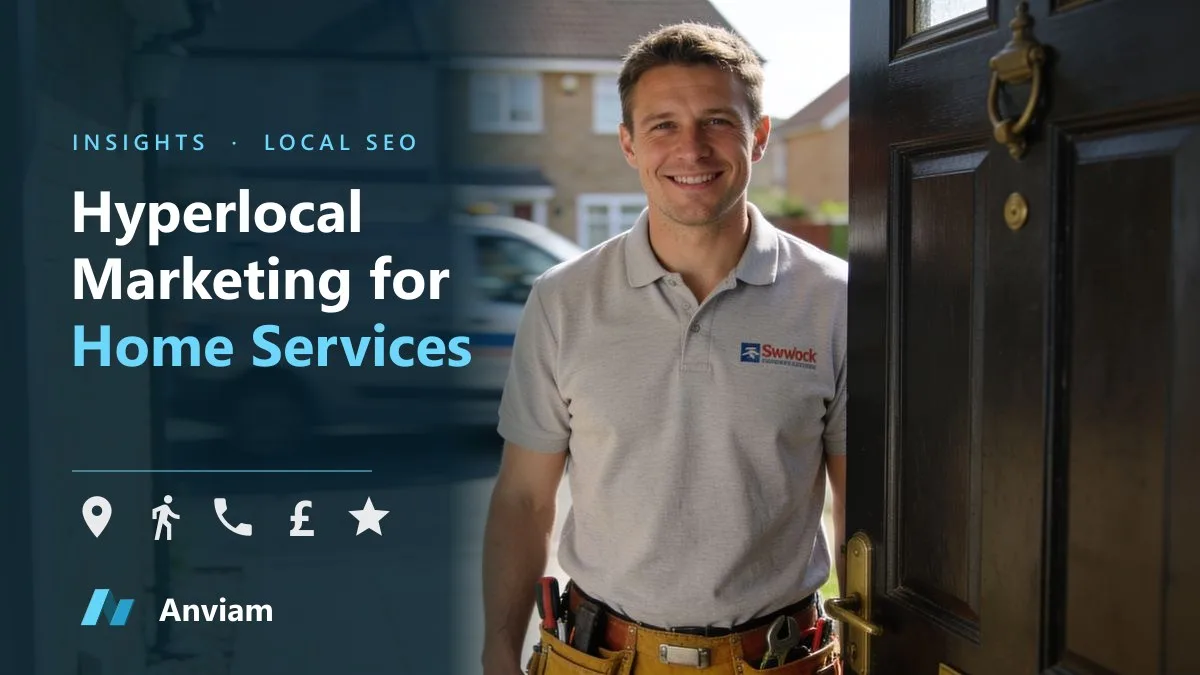
If you fit boilers, clear drains, rewire kitchens or clean homes for a living, the fastest way to a fuller diary is to be the obvious choice for everyone within a short drive of your van. That's what radius marketing does: it puts your business in front of people across your whole service area the moment their boiler packs in, their tap's leaking, or they've decided the house needs a proper clean.
Quick answer
Radius marketing for home services means owning every "near me" search across the miles you already travel. Get your Google Business Profile to 100%, win genuine reviews, then run tightly targeted ads over a 15 to 20 mile radius. Most trades spend about £400 to £500 a month, and they'll usually see their daily enquiries roughly double.
What radius marketing means for home services
You already travel to the job. A plumber doesn't wait for people to walk into a shop; you drive to the breakdown, the blocked drain, the recurring clean. So how far will you go, and does everyone inside that distance know you're there when they reach for their phone?
Radius marketing draws a circle around the postcodes you cover and makes sure your name is the one that shows up for searches like "emergency plumber near me" or "boiler repair" right across it. It's the practical side of hyperlocal marketing: your profile, your reviews, your ads and your website all pointed at the people close enough to serve well and quickly. For the plain-English version, our guide to what hyperlocal radius marketing is walks through it. The point is reach, not spray: be unmissable to everyone inside the distance you're happy to drive.
Why nearby customers are the best
When a boiler dies in February, nobody scrolls to page three of Google. They tap the first trusted name close by and book. BrightLocal, 2025 found 46% of people always or often add "near me" to their searches. For home services that instinct is even stronger, because the job's urgent and the customer wants someone who can actually get there.
Here's the part most trades miss. The households on the edge of town and in the surrounding villages are often the most loyal and easiest to win, because far fewer businesses reach them. A city-centre customer has twenty plumbers fighting over them; a customer two villages out has almost none, so turn up, do a tidy job, and you'll keep them for years. Stretch the radius rather than shrink it. A small travel charge covers the miles, and the loyalty out there is worth far more than the diesel.
See where AI search is hiding your brand
Get a free AI-visibility audit. We'll show where you're missed in Google and AI answers, and the fastest way to get cited.
Setting the right radius for your trade
Home services travel a fair way, so the radius should be generous. For most trades we start at a 15 to 20 mile service area, then push wider for the jobs people happily pay to bring you out for.
A rough guide to radius by job type for home-services trades
| Radius | Best for |
|---|---|
| Up to 5 miles | Dense urban rounds and quick jobs, where you can fit several visits into a day |
| 15 to 20 miles | The usual service area for most trades, and the sweet spot for steady bookings |
| 20 miles and beyond | Specialist or emergency jobs people pay travel for, plus under-served villages worth the drive |
If you only market to a tight five miles, you're fighting the whole town for the same customers. Set it at 15 to 20 miles and add the countryside and you reach loyal households your rivals ignore. Don't under-set it.
Match the radius to the van, not the map
A cleaner running recurring visits might keep it tight for efficiency; a heating engineer chasing emergency callouts should cast wider and charge for distance. Set the radius around the work you want, not a round number on a map.
How we win it
The work follows a clear order, and we fix the free parts first, because rushing to ads before the foundations are right just wastes money. Here's how it goes.
- Google Business Profile to 100%. Always the first thing we fix. Every field filled, every service listed with the words customers actually type, real photos of your work and van, correct hours including out-of-hours cover, and working call and book buttons that match your site. A complete profile is what gets you into the map pack.
- The local directories that matter. After a look at what competitors have done, we get you listed on Yell, Yelp and the trade listings that count in your city, so your name and number match everywhere.
- A genuine reviews programme. Real, keyword-rich reviews from real customers, asked for at the right moment. We never buy fake reviews, and if your reputation's taken a knock we rebuild it with genuine positive ones. This matters: BrightLocal, 2024 found 88% would use a business that replies to all of its reviews, against just 47% for one that never responds. Replying's free, and it wins work.
- Radius-targeted Google and social ads. Once the profile and reviews are earning, we pin paid search and social to your exact service area, so every click comes from inside the distance you'll drive to.
- Conversion-rate work. Last, we tighten the website and follow-up so the enquiries you now get turn into booked jobs, with fast replies and automated chasing of quotes that go quiet.
That order comes straight from our work with trades and contractors. The free foundations do the heavy lifting, and the ads amplify what already works. Underneath it all sit local SEO, PPC, social and reputation management.
What it costs
Most home-services firms we work with spend roughly £400 to £500 a month on a focused single-city programme. To also cover the outskirts and villages, add about 30% to widen the radius and ad reach, and it's usually money well spent given how loyal those customers are. If budget's tight, individual pieces start from around £250 a month, so you can begin with the profile and reviews.
To put that in context, a full nationwide programme, with local SEO, AI and GEO visibility, social, ads, creative and Google Ads management on top, runs roughly ten times a single-city budget. A focused patch costs about a tenth of going national. We'll confirm the exact figure for your trade and area in a free consultation.
What we have learned
After years of filling diaries for trades, two beliefs cost firms the most money. The first is that a local business just needs time, and the work will come if you're patient. It won't. While you wait, the firm two villages over takes the jobs that should have been yours. Sitting still isn't patience, it's lost revenue every week.
The second is that word of mouth will grow you on its own. Referrals are lovely, but they're slow. In our experience most trades pick up only one or two referral customers a month, nowhere near enough to grow on. You need a system that brings strangers to the door.
When the foundations are right, the numbers move. Typically we see daily enquiries roughly double, with firms going from about one qualified customer every two days to one to three new ones a day, more in peak season when the cold snaps and the breakdowns pile up. Organic calls often come in under £4 each, around £90 a month for the organic effort. With paid ads on top, we usually see 5 to 10 calls or booking enquiries a day at about £8 to £12 a call, when some big-city agencies charge £40 to £50 for the same call. And the conversion-rate work, with the automation we run through GoHighLevel, typically lifts a local site's conversion rate by 50% to 100%. A dental clinic we've worked with for years is a good example: same method, same order, and a diary that stays full through the quiet seasons that used to hurt.
Getting started
You don't need to do everything at once. Start where the return is quickest.
- Claim and complete your Google Business Profile, every field, with real photos and working call and book buttons.
- Decide the honest distance you'll travel and set your radius at 15 to 20 miles, stretching into the villages you want.
- Ask your last ten happy customers for a review, and reply to every one you already have.
- Once that's live and earning, layer radius-targeted ads over the exact area you cover.
If you'd rather we did the lot, read the full hyperlocal marketing approach, or skim the guide to hyperlocal marketing and our Google Business Profile near-me ranking strategy. When you want a clear price for your patch, grab a free quote and we'll map it out with you.
Homeowners now diagnose the problem before they ring you
This has changed the first conversation, and most trades have not noticed yet.
A homeowner spots a spreading damp patch, a dripping boiler or a cracked tile. They photograph it, describe it to an AI assistant, and learn the probable cause, how urgent it is, whether they need a plumber, roofer or electrician, the rough cost, and which local firms are well reviewed for it. Then they enquire.
That is a better enquiry than the old one. An AI assistant will not tell someone to ignore a leak or live with damp. It tells them to get it sorted before it worsens, which turns a "maybe later" into a booked visit. The homeowner arrives already knowing roughly what the job is, so quotes convert faster and the price conversation is shorter.
The catch is that the assistant has to know you exist. To be the trade it names you need the things a good local firm would want anyway: a strong local presence, genuine reviews, and content that answers the real questions homeowners ask before they call.
- Answer the diagnostic questions in plain words: why is this happening, who fixes it, what does it usually cost, how urgent is it.
- Be specific about what you do and where. Vagueness is the main reason a business is left out of an AI answer.
- Keep your details identical everywhere, because these tools cross-check your site against directories and reviews before naming anyone.
- Name your people and any trade accreditations. Credentials are a trust signal for AI systems as they are for Google.
Our generative engine optimisation and answer engine optimisation work covers how we track citations across the main engines, and the wider pattern is in our study of how AI search is driving more enquiries.
How big should a home-services radius be?
For most trades we start at a 15 to 20 mile service area and stretch further for emergency or specialist jobs people pay travel for. A tight five-mile radius only suits dense urban rounds with lots of quick jobs, and setting it too small hands the loyal village customers to someone else.
What does radius marketing cost for a trade?
Most home-services firms spend about £400 to £500 a month on a focused single-city programme, with roughly 30% more to also cover the outskirts. Individual pieces start from around £250 a month. A nationwide programme costs roughly ten times a local one, so we'll confirm the exact figure in a free consultation.
How quickly will I see more enquiries?
A complete Google Business Profile and genuine reviews usually start pulling in calls within the first few weeks. In our experience daily enquiries tend to roughly double once the profile, reviews and radius-targeted ads are all working together, and peak seasons lift it further.
Do I really need ads, or will reviews do the job?
Reviews and a complete profile do a lot of the work and keep organic calls cheap, often under £4 each in our experience. Ads come later, once the foundations are earning, to add 5 to 10 booking enquiries a day across your service area. We never run ads over a weak profile, because that'd just waste money.
Was this article helpful?
Rate it and, if you like, drop a question for Ashmeet. We read every one.

Written by
Ashmeet Singh
Head of Branding & Marketing, Anviam
Ashmeet leads branding and marketing at Anviam, where he builds search and AI-visibility programmes for B2B and consumer brands across the UK and Europe. He works day-to-day on SEO, GEO and AEO strategy, helping brands get found in both classic search and AI answer engines like ChatGPT, Perplexity and Google AI Overviews.
Want results like these for your brand?
Book a free consultation and we'll return a prioritised growth plan within five working days.
Get a free consultation →