Automotive SEO and Digital Marketing: The UK Guide for Dealers and Garages
By Ashmeet Singh, Head of Branding & Marketing · Updated 23 October 2026 · 10 min read
UK automotive search works differently: MOT cycles, independent garages and a huge aftermarket the American guides ignore. A practical SEO guide for dealers and garages.
Quick answer
Automotive SEO is the work of being found when someone needs a car, a service or a repair. In the UK that splits into two very different jobs. Franchised dealers compete on stock and brand. Independent garages compete on trust, price clarity and being nearby when something goes wrong. Almost every guide online is written for American dealerships, which is why UK garages in particular are so poorly served by the advice they find.
Why UK automotive search is a different job
Search "automotive SEO" and you get a wall of American content about dealership inventory feeds, manufacturer spec pages and franchise groups. Some of it is excellent. Almost none of it was written for the market you actually trade in.
The UK is structurally different in two ways that change the whole approach. First, we have a very large independent aftermarket: tens of thousands of independent garages, specialists and MOT centres that are not attached to any franchise. Second, we have the MOT, a legal annual test that creates a predictable, date-driven demand cycle with no real American equivalent.
Neither of those appears in the guides ranking at the top of Google for this topic. If you run a garage in Dudley, advice about optimising inventory feeds for a multi-site franchise group is close to useless.
Dealers and garages are not the same business, or the same search problem
This is the distinction most automotive marketing advice collapses, and getting it wrong wastes most of the budget.
Two different search problems
| What matters | Franchised dealer | Independent garage |
|---|---|---|
| The main search | Make, model, finance, "used [car] near me" | "garage near me", "MOT near me", the symptom or the part |
| What wins it | Stock, price, brand trust, finance terms | Proximity, trust, price clarity, availability today |
| Decision speed | Weeks of comparison | Often same day, sometimes urgent |
| Repeat value | Low on the car, high on servicing | Very high. A good garage keeps a driver for years |
| Biggest content need | Inventory, model and finance pages | Service and specialism pages, honest pricing |
| Biggest trust signal | Brand plus reviews | Reviews, almost entirely |
A dealer and a garage can sit on the same street and need almost opposite strategies. The dealer is competing on a considered purchase. The garage is competing to be the one someone rings when the engine light comes on during the school run.
See where AI search is hiding your brand
Get a free AI-visibility audit. We'll show where you're missed in Google and AI answers, and the fastest way to get cited.
How UK drivers actually search
Three patterns matter, and all three favour businesses that have done the basics properly.
Urgency. A large share of garage searches happen because something is wrong right now. The driver is often stressed, usually on a phone, and frequently in a car park. They want to know you are open, you are near, and you can look at it today. Anything that slows that down loses the job.
Symptom first, service second. People search what they can describe, not what the job is called. "Grinding noise when braking", "car won't start clicking", "engine management light on". They do not search "brake caliper replacement". The garage that explains the symptom in plain words gets found earlier than the one listing services.
Recurring, date-driven demand. Every MOT creates a known future search, twelve months out, for every driver you have ever served. Very few UK garages do anything with that at all.
The MOT cycle is an asset, not just a service
This is the most UK-specific opportunity in automotive marketing and the one most consistently wasted.
An MOT is a legal requirement on a fixed annual cycle. That means demand is not random. For every vehicle you have tested, you know roughly when that driver will need you again. You also know that a meaningful number of them will search afresh rather than return automatically, because they have forgotten who did it last year.
Three things follow from that:
- Build a proper MOT page, with price, what is included, how long it takes, what happens if it fails, and how to book. "MOT near me" is a high-intent local search and the page answering it should be genuinely useful, not a line on a services list.
- Capture the reminder. A simple consented reminder before the due date is the cheapest repeat business in the sector. Most garages rely on the driver remembering.
- Treat the MOT as the front door. It is a low-value job that opens a high-value relationship. The content around it should make the rest of what you do visible.
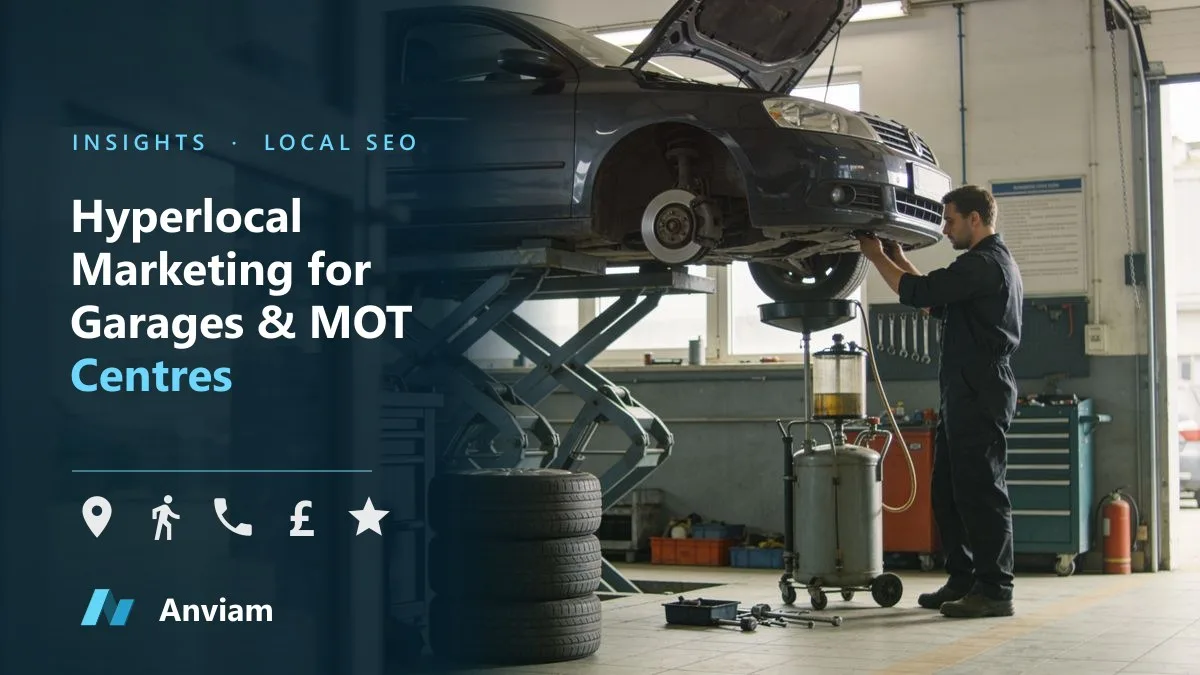
Our guide to hyperlocal marketing for garages and MOT centres goes further into the local radius side of this.
Local SEO: the biggest lever for both
For dealers and garages alike, local search does more work than anything else on this page.
- Google Business Profile, completed properly and per site. Correct categories, real opening hours including Saturdays, every service listed individually, and photographs of the actual premises and team. For garages this is frequently the entire shopfront.
- Opening hours that are actually right. It sounds trivial. A driver who turns up to a closed garage does not come back, and the review they leave is permanent.
- Consistent name, address and phone number across your site, Google, Bing, and the motoring directories. Mismatches weaken local ranking quietly.
- A real page per location for multi-site groups, with its own address, team, services and content. Not one page listing six branches.
- Genuinely local content. Catchment areas, parking, courtesy car arrangements, which estates and villages you cover. Naming a town is not local content.
More detail in our guide to ranking in near me searches and hyperlocal marketing.
What franchised dealers need
- Model and stock pages that are actually indexable, not trapped behind a filter or a feed that renders nothing to a crawler.
- Service and aftersales pages in their own right. Servicing is the profitable, repeating half of the business and it is routinely buried under the sales site.
- Finance and part-exchange content. These are the questions buyers research hardest and the pages dealers write worst.
- Location pages per site, treated as real pages rather than templated stubs.
What independent garages need
This is the part the American guides skip entirely, and where most UK garages have the furthest to go.
- A page per service, written in plain words. MOT, servicing, brakes, clutches, diagnostics, air conditioning, tyres. One per job you want, not a bullet list.
- Symptom content. Explain what a noise, a warning light or a smell usually means, and when it needs looking at urgently. This is what drivers search and what AI assistants quote.
- Specialisms, stated clearly. If you are the local specialist in a marque, in diesels, in EVs or hybrids, say so prominently. Specialism beats generality in search and in trust.
- Honest pricing or price ranges wherever you can. The fear of being overcharged is the single biggest hesitation a driver has about an unfamiliar garage.
- Faces and credentials. Named technicians, qualifications, affiliations and approvals. People are handing over a car worth thousands to strangers.
Reviews carry more weight here than almost anywhere
Automotive repair is a trust purchase made under pressure by someone who usually cannot verify the work themselves. That makes reviews close to decisive.
Ask for them properly and at the right moment, which is when the car is handed back and the relief is fresh. Respond to all of them, including the difficult ones, and respond like a professional rather than arguing. A calm, specific reply to a bad review does more good than ten positive ones, because it shows a future customer what happens when something goes wrong.
Getting found in AI search
Drivers now describe problems to an assistant before they ring anyone. "My car judders when I brake, is it safe to drive", "how much should a clutch cost", "do I need a full service or an interim one". The assistant explains, then usually suggests getting it looked at by a professional, and often names the kind of business that handles it.
That suits a good garage. These tools will not tell someone to ignore a braking fault. They steer people toward getting it checked, which is exactly the outcome you want. The job is to be the business they can confidently name.
- Answer the real question directly, in the first two sentences, under a heading phrased the way it was asked.
- Be explicit about what you do and what it costs. Vagueness is the main reason a business gets left out of an AI answer.
- Keep your details identical everywhere, because these tools cross-check your site against directories and reviews before naming you.
- Name your people and their qualifications. Authorship and credentials are trust signals for AI systems as they are for Google.
- Use proper structure and schema so the answer can be extracted accurately.
Our generative engine optimisation and answer engine optimisation work covers how we track citations across the main engines, and how brands become the source AI models cite explains the mechanics.
Technical foundations
- Fast and mobile first. Most garage searches happen on a phone, often roadside.
- Click to call, prominently. A stressed driver wants a phone number, not a contact form.
- Schema: AutoRepair or AutoDealer, LocalBusiness, opening hours, and FAQPage where you answer questions.
- Indexable service pages. Check they are actually in Google's index, not merely crawled.
- Accurate opening hours in markup as well as on Google.
Our technical SEO checklist covers the rest.
What we have measured
How we measured this
Across 20 client accounts in 6 sectors, including 5 in automotive, we tracked qualified enquiries from January 2025 to October 2026. Enquiries were counted through form fills, calls on dedicated tracking numbers and GA4 traffic composition, then corroborated by asking customers directly during the booking conversation. Automotive clients saw qualified enquiries rise by around 23.3%.
The honest caveats. This is 20 of our own accounts, not a controlled study or market-wide research. AI assistants often pass no clean referrer, so attribution is corroborated rather than perfectly tracked. Other marketing ran alongside for some clients.
The precondition that matters most. These results came on sites already indexed, already ranking, with reasonable authority behind them. A new or barely indexed site needs those foundations first. Anyone promising the outcome without the groundwork is selling you something.
More detail is in our study of how AI search is driving more enquiries.
Measuring what matters
- Calls, tracked properly. In this sector most enquiries are phone calls, so a report built on form fills is measuring the minority.
- Bookings by service, so you can see whether MOT traffic converts into servicing work.
- Local pack visibility for your main services across your catchment.
- Repeat customers, which is the real economics of a garage.
- AI citations, checked across the main engines rather than assumed from Google rankings.
Where to start
If budget and time are tight, in this order.
- Complete your Google Business Profile properly, with correct hours, every service listed, and real photographs. For a garage this is usually the highest-return hour of work available.
- Build a real MOT page and a real page for your most profitable service. These two pages answer the searches that bring in both the quick jobs and the good ones.
- Fix your review process. Ask at handover, respond to everything. In a trust purchase this compounds faster than any content.
After that: symptom content, specialism pages, honest pricing, technical health and AI visibility.
FAQ
What is automotive SEO?
It is the work of making a dealership, garage or motoring business easy to find when someone searches for a car, a service or a repair. In practice that is mostly local search, clear service pages, reviews, and increasingly being named when someone asks an AI assistant about a problem with their car.
Is automotive SEO different for a garage than for a dealership?
Substantially. A dealership competes on stock, brand and finance over a considered purchase of several weeks. An independent garage competes on proximity, trust, price clarity and availability today, often in an urgent situation. The same strategy applied to both will underperform for at least one of them.
How important is the MOT for marketing?
More than most garages treat it. It is a legal annual requirement, so it creates predictable recurring demand and a known date for every vehicle you have tested. A proper MOT page plus a consented reminder is among the cheapest repeat business available in the sector.
How long does automotive SEO take to work?
Local improvements, especially a properly completed Google Business Profile and accurate opening hours, can show results within weeks. Content and authority work usually takes three to six months to show clearly, and longer on a new site. Anyone guaranteeing rankings in 30 days is not being straight with you.
Do reviews really matter that much?
In this sector, yes. Repair is a trust purchase made under pressure by someone who often cannot verify the work. Reviews, and how you respond to the bad ones, do more persuading than any copy on your website.
Should garages worry about AI search yet?
Yes. Drivers describe symptoms to assistants before they ring anyone, and those tools name the kind of business that handles it. Clear service and symptom content, accurate details everywhere and proper structure are what get you named.
Want to know how your dealership or garage shows up when a local driver searches? We run a free visibility audit covering your local presence, your service pages and how you appear across the main AI engines. Request your audit.
Celebrating 10+ years of digital marketing and web development excellence.
Was this article helpful?
Rate it and, if you like, drop a question for Ashmeet. We read every one.

Written by
Ashmeet Singh
Head of Branding & Marketing, Anviam
Ashmeet leads branding and marketing at Anviam, where he builds search and AI-visibility programmes for B2B and consumer brands across the UK and Europe. He works day-to-day on SEO, GEO and AEO strategy, helping brands get found in both classic search and AI answer engines like ChatGPT, Perplexity and Google AI Overviews.
Want results like these for your brand?
Book a free consultation and we'll return a prioritised growth plan within five working days.
Get a free consultation →